CTC Errors
These node and edge error annotations are used to calculate the CTC metrics TRA and DET as well as the basic AOGM metric as described in CTC/AOGM Metrics.
Nodes
True Positives
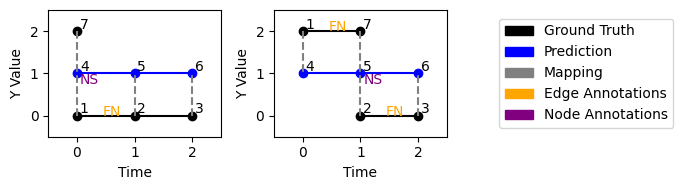
A true positive node is one that is matched to only one node in the predicted graph. Additionally, the predicted node is not matched to any other node in the ground truth. True positive nodes are annotated on both the ground truth and the predicted graph.
False Positives
False positive nodes are annotated on the predicted graph and correspond to a predicted node without a match in the ground truth graph.
False Negatives
False negative nodes are annotated on the ground truth graph and correspond to a ground truth node without a match in the predicted graph.
Non-Split
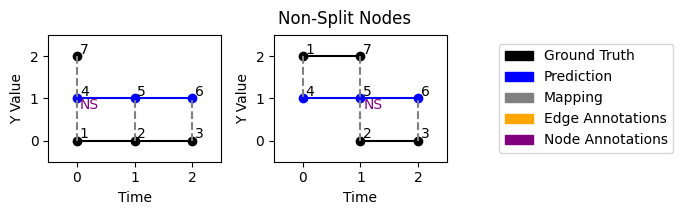
Non-split nodes are annotated on the predicted graph and correspond to a node in the prediction that has been matched to more than one node in the ground truth graph.
Edges
False Positives
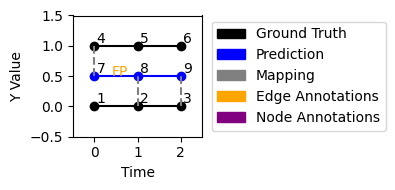
False positive edges are annotated on the predicted graph. An edge is considered a false positive if both nodes are true positive nodes, but the edge does not match to any edge in the ground truth graph. In the example below, edge (7, 8) is a false positive.
False Negatives
False negative edges are annotated on the ground truth graph. An edge is considered a false negative if:
Either node is annotated as a false negative node
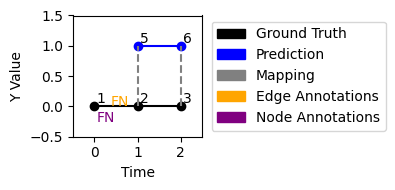
The corresponding edge in the predicted graph does not exist between two true positive nodes
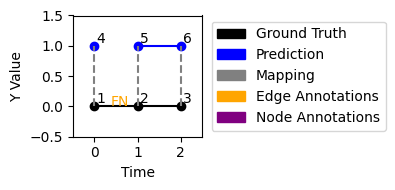
Either node matches to a non-split node in the predicted graph
Intertrack
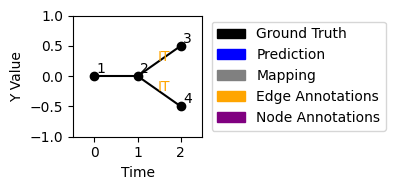
Intertrack edges connect two nodes with different track IDs, most commonly parent cells to daughter cells, or two cells in non-consecutive frames. Note that intertrack edges are not errors, but support the annotation of Wrong Semantic edges, as detailed below.
Wrong Semantic
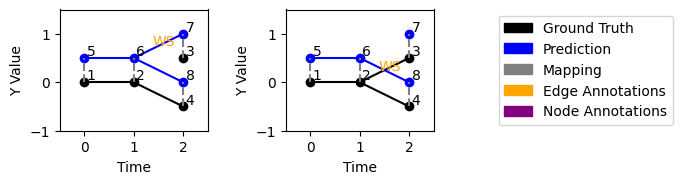
After identifying a matched pair of edges from the ground truth and predicted graphs, the predicted edge is annotated as wrong semantic if the ground truth and predicted edge have different intertrack edge annotations.
Skip Edges
Skip edges must be identical in the ground truth and predicted graphs in order for no errors to be annotated. Otherwise, the appropriate error is annotated as described above.